
A complete industrial and practical guide for formulators, engineers, and procurement teams in India
Silicone oil is one of the most versatile industrial fluids available. From textile softening and mould release in Maharashtra factories to transformer insulation and cosmetic formulations across India, its applications span dozens of industries. But the same product is rarely useful at just one viscosity. A lubrication engineer may need to thin a 1,000 cSt oil so it flows through a narrow passage; a sealant manufacturer may need to thicken a base fluid for better anti-sag performance. In both cases, understanding how to adjust viscosity safely and predictably is essential.
This guide explains exactly how viscosity works in silicone oil, then covers every practical method available to increase or reduce it — with guidance on tools, safety, and sourcing specific to the Indian industrial context.
What is Viscosity, and Why Does it Matter in Silicone Oil?
Viscosity is a fluid’s resistance to flow. Silicone oil is typically expressed in centistokes (cSt) at 25°C. The cSt scale ranges enormously: from 0.65 cSt (thinner than water) to over 1,000,000 cSt (a near-solid gum). The most widely traded industrial grades in India range from 50 cSt to 60,000 cSt.
The chemistry behind viscosity is straightforward. Silicone oil is a polymer called polydimethylsiloxane (PDMS), made up of repeating –Si(CH₃)₂–O– units. The longer the polymer chain (i.e., the higher the molecular weight), the higher the viscosity. A 10 cSt oil has roughly 15 siloxane units per chain; a 1,000 cSt oil has approximately 400; a 10,000 cSt oil has around 800 units.
This direct relationship between chain length and viscosity is why blending is so effective: mixing long- and short-chain PDMS grades predictably shifts the blend’s average chain length and, therefore, its viscosity.
Common Viscosity Grades and Their Uses
The table below summarises the most widely available grades and their primary applications:
| Viscosity Grade | Typical Uses |
|---|---|
| 10–50 cSt | Spray lubricants, release agents, cosmetic serums, low-friction coatings, solvent-carrier blends |
| 100–350 cSt | Mould release, anti-foam agents, textile softeners, polishing compounds, hair and skin care emollients |
| 1,000 cSt | Hydraulic dampers, heat transfer fluids, industrial lubrication, electrical insulation, rubber processing |
| 5,000–12,500 cSt | Heavy-duty damping, seals and gaskets, transformer fluids, high-load bearing lubrication |
| 60,000 cSt and above | Sealant bases, high-viscosity damping systems, torsional vibration dampers, specialty elastomer bases |
One key advantage silicone oil holds over mineral oils is its low viscosity–temperature coefficient (VTC). Because of the low intermolecular forces and high chain flexibility of the Si–O backbone, silicone oil’s viscosity changes far less with temperature than petroleum-based oils do. This stability makes it preferred for applications where temperature swings are common — such as automotive dampers, transformer fluids, and industrial ovens.

How to Reduce the Viscosity of Silicone Oil
Reducing viscosity is the more common requirement in industry. It accounts for the majority of viscosity adjustment queries from lubricant formulators, processing engineers, and cosmetic manufacturers. There are three principal methods: blending with a lower-viscosity grade, heating, and solvent dilution.
Method 1: Blending with a Lower-Viscosity PDMS Grade
Blending is the most practical and widely used technique. It involves mixing your target oil with a lower-viscosity PDMS grade of the same chemical family. Because both fluids share the same Si–O backbone, they mix readily at room temperature without phase separation or altering the oil’s fundamental chemical character.
For example, mixing 1,000 cSt PDMS with 50 cSt PDMS in a 1:1 weight ratio will yield a blend with an intermediate viscosity. The exact result depends on the ratio and the specific grades used. Always verify using a viscometer after blending.
Step-by-step blending procedure:
- Identify your starting and target viscosities.
- Select a compatible lower-viscosity PDMS grade (e.g., 50 cSt or 100 cSt to reduce a 1,000 cSt fluid).
- Weigh out the two components in your chosen ratio using a calibrated scale.
- Combine in a clean stainless steel or HDPE container.
- Mix thoroughly using a mechanical stirrer or paddle mixer at low to medium speed until the blend is fully homogeneous (uniform appearance with no swirling layers).
- Allow the blend to settle for 15–30 minutes, then measure its viscosity with a calibrated viscometer (e.g., a Brookfield or a Cannon-Fenske).
- Adjust the ratio incrementally until the target viscosity is reached.
Pro tip: Use only the same grade of PDMS (e.g., both must be pure dimethylsilicone fluid with no functional groups or additives). Mixing PDMS with amino- or hydroxy-functional silicone oils can introduce unwanted chemical reactions.
Method 2: Heating (Temporary Viscosity Reduction)
Heating is a fast and chemical-free way to reduce viscosity. As the temperature rises, the kinetic energy of the polymer chains increases, reducing the attractive forces between them and allowing them to move more freely. The effect is significant: for a 1,000 cSt oil at 25°C, viscosity can drop to approximately 300–400 cSt at 100°C, and as low as 100–150 cSt at 200°C, depending on the exact formulation.
This behaviour is described in peer-reviewed research: the apparent viscosity of PDMS decreases exponentially with temperature, a relationship well documented in the Journal of Physical Chemistry B (Romano et al., 2017) and in the Journal of Plastination (2018), which studied rheological behaviour over the range of −5°C to 35°C.
Important limitations of heating:
- The effect is entirely temporary. When the oil cools, viscosity returns to its original value.
- Standard PDMS silicone oil can withstand continuous use up to approximately 200–250°C. Above 250°C, thermal degradation begins, producing volatile compounds and reducing lubricating performance. The Shin-Etsu KF-series, for example, is rated for open-system use up to 250°C.
- In processing applications such as injection moulding or heat transfer, the reduced viscosity at elevated temperature is often a benefit rather than a limitation.
Safety note: When heating silicone oil in open vessels, ensure adequate ventilation. While PDMS itself is non-flammable, some low-viscosity grades contain volatile components that may vaporise at elevated temperatures.
Method 3: Solvent Dilution
Solvent dilution is an effective method for achieving substantial viscosity reduction, particularly in coating, release agent, and surface treatment applications where a diluted formulation is applied and the solvent then evaporates.
Silicone oil is highly soluble in non-polar and aromatic hydrocarbon solvents. According to Clearco Products’ technical documentation, silicone fluid is highly soluble in solvents such as toluene, xylene, ligroin, and mineral spirits, as well as in chlorinated hydrocarbons. Polar solvents such as alcohols and acetone are not effective for dissolving PDMS.
Common solvents used in practice:
- n-Heptane: Low toxicity relative to aromatic solvents, good solvency, fast evaporation. Preferred for lab and cosmetic applications.
- Toluene: Strong solvency, widely available industrially, but classified as hazardous under India’s Manufacture, Storage and Import of Hazardous Chemical Rules, 1989. Requires proper PPE (gloves, goggles, ventilation) and storage away from ignition sources.
- Xylene: Similar to toluene; used in industrial coating dilutions.
- Mineral spirits / naphtha: A practical, lower-hazard option commonly available in India for industrial-scale dilutions.
Key considerations for solvent dilution:
- The reduced viscosity is permanent only for as long as the solvent remains in the blend. Once the solvent evaporates, viscosity returns toward the original value.
- Always test for phase stability: incompatible solvent systems can cause the silicone to separate or precipitate. Observe the blend over 24–72 hours.
- For critical applications, measure the final viscosity with a viscometer after solvent blending and again after 24 hours to check for any change.
India safety reminder: Toluene and xylene are regulated flammables. In Maharashtra and Gujarat, handling and storage in quantities above threshold limits may require factory licensing and fire safety compliance under the Petroleum Act. Always check applicable state regulations.

How to Increase the Viscosity of Silicone Oil
Increasing the viscosity of silicone oil is less commonly needed but critical for applications such as sealants, high-load dampers, paste-grade lubricants, and anti-sag coatings. There are three primary approaches: blending with a higher-viscosity PDMS grade, incorporating fumed silica as a thickening filler, and using polymer cross-linking additives.
Method 1: Blending with a Higher-Viscosity PDMS Grade
Just as blending with a lighter grade reduces viscosity, blending with a heavier grade increases it. This is the cleanest and most reversible method. Mixing a 1,000 cSt base oil with a 12,500 cSt or 60,000 cSt PDMS grade will raise the overall viscosity in a predictable manner, provided both grades are pure PDMS of the same chemistry.
An important industrial consideration: as documented in US patent US6348437B1 (Dow Corning), PDMS blends for use in lubricants and hydraulic fluids exhibit improved viscosity stability when the polydispersity (Mw/Mn) exceeds 1.5. Blending two grades inherently raises polydispersity, which contributes to long-term viscosity stability in service.
The blending procedure is identical to that described above for viscosity reduction, simply substituting a higher-viscosity grade for the lower one. Verify with a viscometer after each incremental addition.
Method 2: Adding Fumed Silica (Aerosil / Cab-O-Sil)
For applications requiring a substantial increase in viscosity or the creation of thixotropic (gel-like, flow-on-shear) behaviour — such as silicone sealants, pastes, or anti-sag coatings — the most effective route is incorporating fumed silica.
Fumed silica consists of fine, amorphous SiO₂ particles with surface areas of 100–400 m²/g. When dispersed in PDMS, the silanol groups on the silica surface form hydrogen bonds with the polysiloxane chains, creating a three-dimensional network that dramatically increases viscosity and imparts thixotropy. Research published in e-Polymers (Peng et al., 2021) and by the Adhesives & Sealants Industry confirms that hydrophilic fumed silica (such as Aerosil 200 from Evonik) is highly effective at thickening non-polar silicone systems.
Practical guidance:
- Hydrophilic grades (e.g., Aerosil 200, Cab-O-Sil M-5) are most effective for thickening PDMS. They work through hydrogen bonding between surface silanol groups and the polysiloxane chains.
- Hydrophobic grades (e.g., Aerosil R972, Aerosil R805) are used when lower thickening efficiency is acceptable but improved moisture resistance and long-term stability are required.
- Typical loading levels: 1–5% w/w for moderate thickening; 8–15% w/w for paste-grade or sealant formulations.
- Dispersion requires high-shear mixing. A Cowles dissolver or planetary mixer is preferred for industrial quantities. Hand mixing is insufficient to fully break down silica agglomerates.
- Once dispersed, the viscosity of the composition will continue to rise slightly during storage (a phenomenon called “crepe hardening” or “structuring”). Allow the final composition to stabilise for 24–48 hours before measuring final viscosity.
Trade-off to note: Adding fumed silica reduces optical clarity and may affect thermal conductivity. For applications requiring transparent fluids (e.g., optical equipment, certain medical devices), fumed silica thickening is not appropriate.
Method 3: Polymer Additives and Cross-Linking
For specialised formulations, higher-molecular-weight PDMS gums or reactive crosslinking systems can be incorporated to substantially increase viscosity. This approach is typically used in elastomer compounding and room-temperature-vulcanising (RTV) silicone preparations, and is best handled by specialist formulators with access to technical data from manufacturers such as Wacker, Shin-Etsu, or Momentive. It is not recommended for straightforward industrial blending without proper formulation expertise.
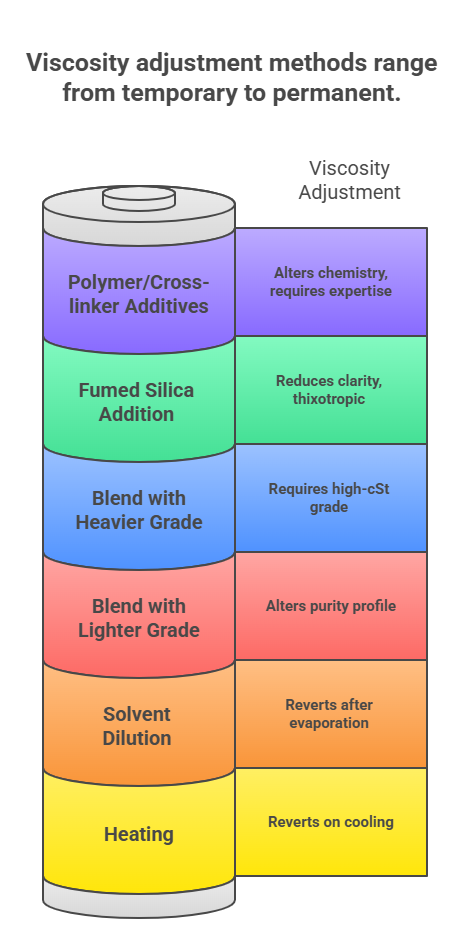
Comparison of All Methods at a Glance
The table below summarises all adjustment methods to help you select the most appropriate approach for your application:
| Method | Direction | Permanent? | Ease | Key Trade-off | Best For |
|---|---|---|---|---|---|
| Blend with lighter grade | Reduce | Yes | Easy | Slightly alters purity profile | Industrial lubrication, pump fluids, processing |
| Heating | Reduce | No (temporary) | Easy | Reverts on cooling; degradation risk above 250°C | Processing, moulding, heat transfer |
| Solvent dilution (heptane/toluene) | Reduce | Depends on evaporation | Moderate | Flammability/safety; reverts after evaporation | Coating, release agent, surface treatment |
| Blend with heavier grade | Increase | Yes | Easy | Requires availability of high-cSt grade | Damping fluids, heavy lubrication |
| Fumed silica addition | Increase | Yes | Moderate (needs high-shear mixing) | Reduces clarity; thixotropic behaviour | Sealants, pastes, anti-sag coatings |
| Polymer/cross-linker additives | Increase | Yes (chemical change) | Difficult | Requires formulation expertise; alters chemistry | RTV compounds, elastomer bases |
Sourcing and Safety Considerations in India
India has a well-developed silicone oil supply chain, with authorised distributors and specialist suppliers active across major industrial hubs. The grades most commonly available ex-stock in India include 10, 50, 100, 350, 1,000, 5,000, 12,500, and 60,000 cSt — sourced from leading global manufacturers such as Wacker, Momentive, and Shin-Etsu, and distributed through established channels in Mumbai, Ahmedabad, Aurangabad, Pune, and Vapi.
Domestic sourcing of PDMS silicone oil has become increasingly viable in recent years, with the full viscosity range from 0.65 cSt to 60,000 cSt available without long lead times.
Pricing Guidance
For common grades (50–1,000 cSt), pricing varies based on order quantity, grade, and brand. Bulk orders and long-term supply arrangements typically unlock better rates and guaranteed availability.
Gaurav Impex supplies a wide range of silicone oil viscosity grades across India — with Certificates of Analysis, competitive bulk pricing, and technical support to help you select the right grade for your application. Contact us for a quote.
Storage and Handling
- Store silicone oil in sealed HDPE or stainless steel drums at 5–35°C, away from direct sunlight.
- Silicone oil itself is non-toxic and non-flammable. However, low-viscosity grades (below 50 cSt) have lower flash points and should be stored away from ignition sources.
- Toluene and xylene, used as solvents for dilution, are classified as hazardous chemicals under the Manufacture, Storage and Import of Hazardous Chemical Rules, 1989. Adequate ventilation, PPE (nitrile gloves, splash goggles), and proper waste disposal are mandatory.
- In India’s high-ambient-temperature conditions (especially in summer months in Gujarat, Maharashtra, and Telangana), solvent-based blends evaporate more rapidly than in temperate climates. Take additional precautions to prevent unintended changes in viscosity caused by solvent evaporation during storage or application.
Frequently Asked Questions
Does heating permanently reduce silicone oil viscosity?
No. Heating causes a temporary, reversible reduction in viscosity. Once the oil returns to ambient temperature, viscosity recovers fully. This is confirmed by the research on temperature-dependent rheological behaviour of PDMS published in the Journal of Physical Chemistry B (2017). If you need a permanent reduction, use blending or solvent dilution.
Can I mix two different viscosity grades of silicone oil?
Yes, provided both are the same chemical type — i.e., both are pure PDMS (dimethylsilicone oil) without functional modification. Mixing standard PDMS grades is clean and predictable. Do not mix PDMS with amino-functional, carbinol-functional, or other chemically modified silicone fluids without technical guidance, as these may react or give unexpected results.
Which solvent is best for thinning silicone oil?
n-Heptane is generally preferred for laboratory and cosmetic applications because it has relatively low toxicity and evaporates cleanly. Toluene and xylene are effective but are regulated as hazardous in India and require proper safety precautions. Mineral spirits or naphtha are a practical lower-hazard option for industrial quantities. Avoid alcohols (ethanol, IPA) and ketones (acetone) as standalone solvents — they are not effective at dissolving PDMS.
What is fumed silica, and where can I source it in India?
Fumed silica (also called pyrogenic silica) is a fine white powder used as a rheology modifier and thickener. Common trade names include Aerosil (Evonik) and Cab-O-Sil (Cabot). In India, it is available through chemical distributors in Mumbai, Ahmedabad, and Delhi. Hydrophilic grades (Aerosil 200, Aerosil 300) are used for thickening non-polar silicone systems.
Does silicone oil viscosity change with temperature in normal use?
Yes, but far less than mineral oils. Silicone oil has a low viscosity–temperature coefficient, meaning its flow properties are relatively stable across a wide temperature range. This is one of its key industrial advantages. A 1,000 cSt oil used in a system that swings between 0°C and 80°C will show a much smaller viscosity change than an equivalent mineral oil, making silicone the preferred choice for applications exposed to temperature variation.
How do I measure viscosity after adjusting it?
Use a calibrated viscometer. For low-to-medium viscosity oils (up to approximately 10,000 cSt), a Cannon-Fenske glass capillary viscometer or a Ubbelohde viscometer is appropriate. For higher viscosities or thixotropic silica-filled compounds, a rotational viscometer (such as a Brookfield) is preferred. Always measure at 25°C to align with the standard grade specifications.
Where can I source custom viscosity silicone oil in India?
Authorised distributors of Wacker, Shin-Etsu, and Momentive silicone fluids operate across India’s major industrial cities. Indian manufacturers, such as those based in Aurangabad, also supply a wide range of grades. For custom blends or specific viscosity requirements, contact a specialist distributor who can provide a Certificate of Analysis (CoA) with each batch. Always request technical data sheets and verify viscosity at 25°C before use.
Conclusion
Adjusting silicone oil viscosity is a well-understood, practical process when approached systematically. For most industrial applications, blending with a different-viscosity PDMS grade is the safest, most predictable, and most reversible approach — whether you need to go lighter or heavier. Heating is a useful option when only temporary thinning is needed. Fumed silica is the route to follow when you need a substantial increase or thixotropic character for sealants or pastes. Solvent dilution serves coating and release-agent applications well, provided safety protocols are followed.
In all cases, verify viscosity with a calibrated viscometer before committing to a formulation, and work with a supplier who can provide technical documentation — particularly when the application is load-bearing, electrical, or pharmaceutical.
Sources referenced:
- Romano et al. (2017). Temperature Effect on Rheological Behavior of Silicone Oils. Journal of Physical Chemistry B, 121(29), 7048–7054.
- Journal of Plastination (2018). Influence of the Temperature on the Viscosity of Different Types of Silicone.
- Peng Z. et al. (2021). Structuring of hydroxy-terminated polydimethylsiloxane filled by fumed silica. e-Polymers, 21(1).
- US Patent US6348437B1 – Silicone Oils with Improved Viscosity Stability (Dow Corning).
- Gelest Inc. – Silicone Fluids Property Profile Guide.
- Clearco Products – Introduction to Silicone Fluids and Solubility of Silicone Fluids.
- Shin-Etsu Chemical – Silicone Fluid (North & South America) Technical Datasheet.
- Evonik – AEROSIL Fumed Silica in Sealants (Technical Bulletin 63).