
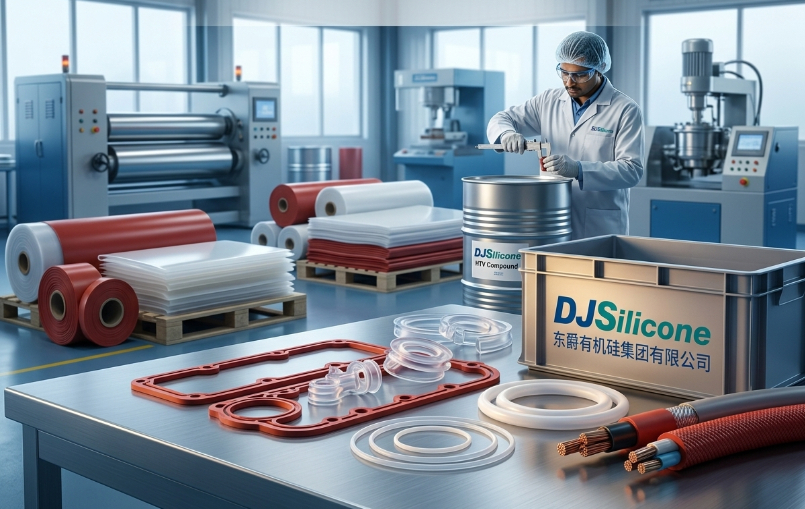
If you work in manufacturing, you already know that not all rubber is created equal. Choosing the wrong elastomer for a gasket, seal, or insulation component can mean costly failures, compliance nightmares, and production downtime. That is why more and more Indian manufacturers, from automotive OEMs to pharmaceutical processors, are turning to DJ Silicone Rubber as their go-to material.
But sourcing the right grade, from the right supplier, with the right documentation? That is where things get complicated, especially in a market as diverse and fast-moving as India’s.
This guide covers everything you need to know about DJ Silicone Rubber in India: what it is, how it is made, the full range of available grades, key technical properties, industrial applications across India’s key sectors, price factors, how to read a datasheet, and critically, why buying from an authorized distributor like Gaurav Impex protects both your production line and your bottom line.
What Is DJ Silicone Rubber?
DJ Silicone Rubber refers to the range of high-performance silicone rubber compounds manufactured by Dongjue Silicone Group Co., Limited — specifically through its primary production subsidiary, Dongjue Silicone (Nanjing) Co., Ltd., based in Nanjing, Jiangsu Province, China.
Dongjue (DJ) Silicone is one of Asia’s most established silicone rubber manufacturers, producing a comprehensive portfolio of solid silicone rubber compounds, fumed silicone rubber, fluorosilicone rubber, and liquid silicone rubber (LSR), all manufactured under consistent quality standards.
At a chemistry level, silicone rubber is a synthetic elastomer built on a polydimethylsiloxane (PDMS) backbone — a repeating chain of silicon and oxygen atoms, with organic groups (typically methyl or vinyl) attached to the silicon. This inorganic Si–O backbone is what gives silicone rubber its extraordinary stability across temperature extremes, something organic rubbers like natural rubber or EPDM simply cannot match at the same level.
DJ Silicone compounds are supplied as ready-to-process raw material formulated with reinforcing fillers (fumed silica or precipitated silica), crosslinking agents, and functional additives, allowing manufacturers to mold, extrude, or press-cure finished components directly.
What distinguishes DJ Silicone from generic silicone compounds available in the grey market is consistency: consistent batch-to-batch quality, traceable manufacturing standards, and technical documentation that procurement and quality teams can actually rely on.
Types and Grades of DJ Silicone Rubber
One of the most important decisions any procurement engineer or rubber technologist faces is grade selection. DJ Silicone’s product portfolio covers a broad spectrum, organized by processing method, performance profile, and functional requirement. Here is a structured overview of what is available through Gaurav Impex in India.
Silicone Rubber Compounds for Molding and Extrusion
This is the core category — heat-cured silicone rubber (HCR) compounds ready for compression molding, transfer molding, or extrusion processing.
Standard Silicone Rubber for Molding The workhorse of the range. Balanced hardness, good mechanical properties, and reliable processability make this the default choice for general industrial components.
Common Silicone Rubber for Molding A cost-effective option for applications where performance demands are moderate — suitable for seals, gaskets, and profiles where extreme conditions are not a factor.
Economic Silicone Rubber for Molding and Extrusion Designed to deliver acceptable performance at an optimized cost point. Popular with manufacturers balancing quality with production economics.
Economy Silicone Rubber for Molding / Extrusion Entry-level grades for non-critical applications, available in both molding and extrusion formulations.
Performance Grades
High-Strength Silicone Rubber for Molding: Enhanced tensile strength and tear resistance for demanding mechanical applications, components subject to stress, flexing, or abrasion.
High Rebound Silicone Rubber: Engineered for applications requiring rapid elastic recovery, shock pads, dampers, and dynamic sealing applications where compression set matters.
High Temperature Resistant Silicone Rubber: Formulated to maintain integrity at extended elevated temperatures beyond the standard range, ideal for applications adjacent to heat sources, engines, or industrial ovens.
Ultra-Low Hardness Silicone Rubber: Shore A hardness in the very low range, used in soft-touch components, medical-adjacent applications, and specialty molded parts requiring extreme flexibility.
Specialty and Functional Grades
Food Contact Silicone Rubber for Molding: Meets food safety requirements for direct contact applications in food processing, packaging, and beverage equipment. This grade supports compliance with relevant regulatory standards for food-contact materials.
Antistatic Silicone Rubber: Incorporates conductive additives to dissipate static charge, critical for electronics manufacturing environments, clean rooms, and explosive atmosphere-adjacent applications.
Self-Lubricating Silicone Rubber: Contains internal lubricants that reduce surface friction without external lubrication — used in dynamic sealing, sliding contacts, and components requiring low-friction surfaces over extended service life.
Modified Silicone Rubber for Molding: Functional modifications targeting specific processing or performance requirements — available in formulations that address particular application challenges.
Additional (Addition) Curing Silicone Rubber: Platinum-catalysed addition-cure system for cleaner, by-product-free curing — used in applications requiring low volatiles, high purity, or precision dimensional control.
Fumed Silicone Rubber
A sub-category distinguished by the use of fumed silica (pyrogenic silica) as the primary reinforcing filler rather than precipitated silica. Fumed silica reinforcement delivers superior mechanical properties, higher transparency, and better surface finish.
Available in general-purpose, standard, high-tear-strength, high-transparency, and economic grades, for both molding and extrusion applications.
Fluorosilicone Rubber
A specialized variant where fluorine-containing groups replace some of the organic side chains, dramatically improving resistance to fuels, oils, and solvents, while retaining silicone’s thermal stability. Available in extrusion, molding, and adhesive series.
Liquid Silicone Rubber (LSR)
Two-part, platinum-cured systems for injection molding applications requiring precision geometry, thin walls, or biocompatibility. Used extensively in medical devices, automotive connectors, and consumer electronics.
Fire Retardant Grades
Flame Retardant Silicone Rubber — passes UL94 V-0 or equivalent flame classifications for applications in electrical enclosures, cable management, and building systems.
Ceramic Silicone Rubber — an advanced fire-protection material that ceramicizes at extreme temperatures, maintaining structural integrity even in fire — used in circuit integrity cables and fire-survival applications.
Electrical Insulating Silicone Rubber
Formulated for high dielectric strength and insulation performance, used in cable insulation, transformer components, and high-voltage applications across India’s power infrastructure and electrical manufacturing sectors.
Key Technical Properties of DJ Silicone Rubber
Understanding what silicone rubber can and cannot do is essential before specifying it for any application. Below are the primary performance characteristics that make DJ Silicone rubber compounds stand out.
Thermal Performance
Silicone rubber’s defining advantage over organic elastomers is its thermal stability. Standard DJ Silicone compounds operate continuously across a range of approximately -55°C to +200°C, with high-temperature grades extending performance up to +250°C and beyond for short-term exposure. At the cold end, silicone retains flexibility at temperatures where most organic rubbers would crack or harden — critical for outdoor applications in cold climates or refrigerated environments.
Mechanical Properties
DJ Silicone compounds are available across a Shore A hardness range of approximately 20 to 80, covering everything from ultra-soft flexible grades to harder, more structural compounds. Tensile strength, elongation at break, and tear strength vary by grade and filler system, with fumed silica-reinforced grades delivering superior mechanical performance compared to precipitated silica-based counterparts.
Electrical Insulation
Silicone rubber exhibits excellent dielectric properties, high volume resistivity, high dielectric strength, and good arc resistance. These properties are stable across the full service temperature range, making silicone the material of choice for wire and cable insulation, electrical connectors, and high-voltage applications.
Chemical and Environmental Resistance
DJ Silicone rubber demonstrates strong resistance to UV radiation, ozone, weathering, and oxidation — making it exceptionally durable in outdoor exposure over years of service. It resists dilute acids, alkalis, and many industrial fluids, though it is not suited to concentrated solvents or fuels without fluorosilicone modification.
Compression Set
Low compression set — the tendency to permanently deform under sustained compressive load, is critical for sealing applications. Silicone rubber, when properly cured and post-cured, delivers excellent compression set resistance that maintains sealing force over long service intervals.
Biocompatibility
Specific grades of DJ Silicone rubber, including food-contact and addition-cure grades, are formulated for biocompatibility, non-toxic, odourless, tasteless, and suitable for contact with food, beverages, pharmaceuticals, and body-adjacent medical applications.
Processing Characteristics
DJ Silicone compounds are engineered for consistent processability — predictable Mooney viscosity, good shelf life, and reliable cure kinetics that translate to stable production cycles in compression, transfer, and extrusion processing.
Industrial Applications of DJ Silicone Rubber in India
India’s industrial landscape is diverse and growing rapidly. Across sectors, manufacturers are discovering that the performance envelope of silicone rubber, particularly from a premium supplier like DJ Silicone, justifies the investment premium over commodity elastomers.
Automotive Industry
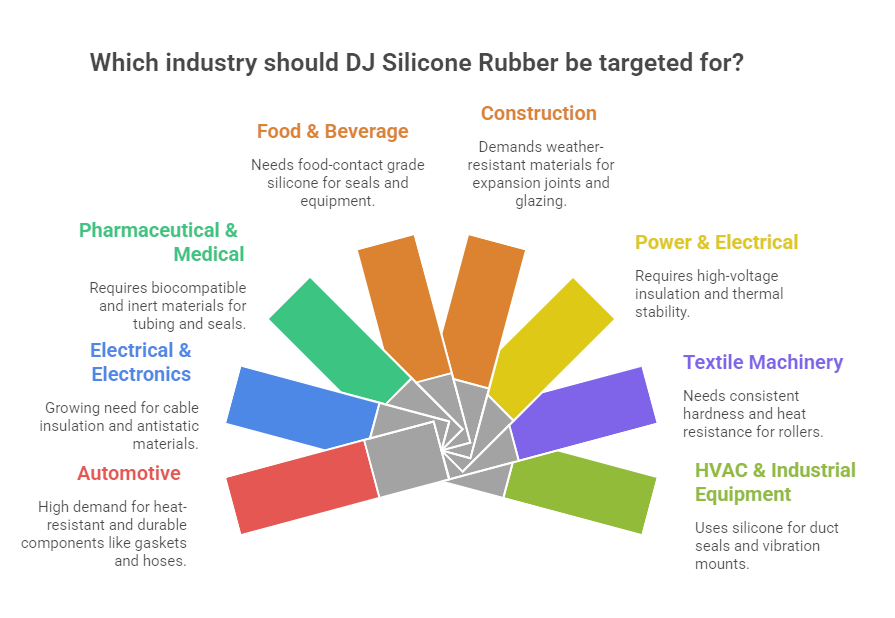
India’s automotive sector, from OEMs in Pune and Chennai to component manufacturers across the country, is one of the largest consumers of silicone rubber. Applications include engine gaskets and seals, turbocharger hoses, spark plug boots, grommet seals, HVAC system components, and vibration dampers. The combination of heat resistance, low compression set, and long service life makes silicone the engineer’s first choice for under-bonnet and exhaust-adjacent components.
Electrical and Electronics Manufacturing
India’s rapid expansion in electronics manufacturing, particularly under the PLI schemes, is driving strong demand for cable insulation grades, keyboard keypads, connector seals, switchgear components, and electronic device gaskets. Antistatic grades are increasingly specified for ESD-sensitive production environments.
Pharmaceutical and Medical
The pharmaceutical industry in India, one of the world’s largest generics manufacturers, requires silicone tubing, pump diaphragms, stoppers, and seals that comply with stringent biocompatibility and chemical inertness standards. Addition-cure and food-contact grades are the materials of choice here. Medical device manufacturers are similarly adopting LSR for precision-molded components.
Food and Beverage Processing
India’s food processing industry is growing rapidly, with stricter hygiene standards being applied at scale. DJ Silicone’s food-contact grade silicone rubber is used in seals, gaskets, conveyor components, and kitchen equipment parts, safe for direct contact with foodstuffs and capable of withstanding steam sterilization.
Construction and Infrastructure
India’s ongoing infrastructure boom, roads, metro systems, airports, and commercial real estate, creates sustained demand for expansion joint seals, glazing profiles, weather-stripping, and structural gaskets. Silicone rubber’s weatherability and UV resistance make it the preferred material for long-life construction sealing applications.
Power and Electrical Infrastructure
India’s power sector modernization is driving demand for high-voltage cable insulation, transformer bushings, surge arrestor components, and overhead line spacers. DJ Silicone’s electrical insulating grades deliver the dielectric performance and thermal stability these applications require.
Textile Machinery
India remains a global textile manufacturing hub. Silicone rubber rollers, printing blankets, and pressure rollers for spinning, weaving, and printing machinery require consistent hardness, surface quality, and resistance to heat and chemical exposure in process environments.
HVAC and Industrial Equipment
Duct seals, equipment gaskets, access panel seals, and vibration isolation mounts in commercial and industrial HVAC systems represent a substantial application segment. Silicone’s temperature range and long service life reduce maintenance intervention in installed systems.
DJ Silicone Rubber Price in India — What Determines the Cost?
Price is naturally a central concern for any procurement team evaluating silicone rubber. Understanding what drives cost helps you budget accurately and evaluate supplier quotes critically.
Grade and Specification The single biggest price variable. General-purpose and economic grades are priced significantly lower than specialty grades (food-contact, antistatic, high-temperature, flame retardant). The performance premium is real and, in regulated applications, non-negotiable.
Filler System Fumed silica-reinforced grades command a premium over precipitated silica grades due to higher raw material cost and superior mechanical properties. If your application does not require the performance uplift, precipitated silica grades offer a better cost profile.
Processing Form Compounds formulated specifically for extrusion have different additive and viscosity profiles compared to molding grades — with corresponding pricing differences.
Order Quantity and Frequency Silicone rubber compounds are imported in bulk — pricing reflects economies of scale. Higher MOQs and consistent monthly volumes attract better pricing from your distributor. Irregular small orders carry a logistical premium.
Global Silicon Metal and Silicone Monomer Markets Upstream silicone monomer pricing is linked to silicon metal production (primarily in China), electricity costs, and global supply-demand dynamics. Market shifts in these fundamentals flow through to compound pricing with a lag of weeks to months.
Import Duties and GST DJ Silicone Rubber is imported from China to India. Applicable customs duties and 18% GST on silicone rubber compounds form a fixed structural cost component that all legitimate importers are subject to equally.
Authorized vs. Grey Market Sourcing Here is where price comparisons can be deceptive. Grey-market or counterfeit silicone compounds occasionally circulate in India at lower prices, but without provenance, certification, or quality consistency. The apparent cost saving is quickly erased by production failures, rework, and regulatory non-compliance in audited supply chains.
Current pricing is available on request — contact Gaurav Impex for a grade-specific quotation based on your volume and application requirements.
Understanding the DJ Silicone Rubber Data Sheet
When you receive a Technical Data Sheet (TDS) for a DJ Silicone compound, knowing how to read it correctly accelerates grade selection and procurement decisions.
What a TDS Contains
A standard DJ Silicone TDS covers the following parameters for each grade, typically reported after standard test cure conditions:
Physical State and Appearance — Colour, form (sheet, pellet, strip), and base compound viscosity.
Hardness (Shore A) — The measure of surface hardness. Lower numbers (20–30) indicate very soft, flexible compounds. Higher numbers (60–80) indicate harder, more structural grades. For sealing applications, match hardness to the compression load and sealing gap.
Tensile Strength (MPa) — The maximum stress the cured compound withstands before failure. Higher is better for mechanically demanding applications.
Elongation at Break (%) — How far the material stretches before tearing. High elongation indicates flexibility and resistance to tearing under dynamic load.
Tear Strength (kN/m) — Resistance to crack propagation. Critical for components with sharp geometry or repeated flexing.
Compression Set (%) — Permanent deformation after sustained compressive load. Lower values indicate better long-term sealing performance.
Specific Gravity — Relevant for weight calculations in finished component design and cost-per-volume comparisons.
Operating Temperature Range — The confirmed continuous service temperature window.
Cure System — Peroxide-cured grades require post-cure to remove volatile cure by-products. Platinum (addition) cured grades do not, and are preferred in clean-room and food/medical applications.
Compliance Certifications to Look For
Depending on your application, look for references to:
- RoHS Compliance — Restriction of hazardous substances (electronics and electrical)
- FDA / Food Contact Compliance — For food-processing and beverage applications
- UL94 V-0 — Flame retardant classification for electrical applications
- REACH Compliance — European chemical regulations (relevant for export-oriented manufacturers)
Gaurav Impex provides TDS and MSDS/SDS documentation for all DJ Silicone grades as part of standard supply support.
Why Buy DJ Silicone Rubber from Gaurav Impex — India’s Authorized Distributor
This is not a rhetorical question. In India’s industrial raw materials market, the chain of supply between a global manufacturer and a domestic production line involves real risks. Here is why authorized distribution matters — and why Gaurav Impex specifically is the right partner for DJ Silicone procurement in India.
Official Authorization — Verified and Published
Gaurav Impex is listed as the sole authorized distributor of Dongjue Silicone (Nanjing) Co., Ltd. for the whole territory of India, directly on the official DJ Silicone website’s Dealer page. This is not a self-claim. It is manufacturer-published, publicly verifiable, and unambiguous. No other Indian entity holds equivalent authorization for the entire Indian market.
When you source through Gaurav Impex, you are buying directly within the manufacturer’s approved distribution chain. Every kilogram is genuine DJ Silicone material, not an imitation, not a substitute, not a blend.
Consistent Quality and Batch Traceability
Authorized distributors receive product with full batch documentation, enabling traceability from manufacturer production lot to your incoming goods inspection. For industries like pharma, food processing, and automotive tier-1 supply, this traceability is not optional. It is a quality system requirement.
Grade Selection Expertise
Not every procurement inquiry starts with a known grade reference. Often, a manufacturer needs to match a performance requirement to the right compound. Gaurav Impex’s team provides application-based technical guidance — helping you identify the correct hardness, cure system, and functional grade rather than defaulting to a generic compound that may underperform in service.
Technical Documentation on Demand
Need the TDS before raising a purchase order? MSDS for your EHS team? Certificate of Analysis for the incoming batch? Gaurav Impex provides complete technical documentation as a standard part of the supply relationship — not an afterthought.
Pan-India Reach from Mumbai
Operating from Mumbai — India’s primary import gateway, Gaurav Impex coordinates reliable logistics to manufacturers across the country. Whether your facility is in Pune, Ahmedabad, Bengaluru, Chennai, Hyderabad, Delhi NCR, or any other industrial hub, bulk supply with appropriate lead times is manageable.
B2B and Bulk Supply Focus
Gaurav Impex operates exclusively in the industrial B2B space. There are no retail quantities, no catalogue ambiguity. The entire operation is structured around supporting manufacturing partnerships — volume supply, consistent grade availability, and long-term sourcing relationships. This focus means your requirements are handled by a team that understands production schedules and supply continuity.
Protection Against the Grey Market
India’s industrial raw materials market has a documented grey-market problem in silicone rubber, compounds of unknown provenance, inconsistent quality, and no manufacturer backing, sold at prices that seem attractive until the first production failure. Sourcing through Gaurav Impex eliminates this risk entirely.
Frequently Asked Questions About DJ Silicone Rubber
What is the difference between DJ Silicone Rubber and standard silicone rubber compounds available in the Indian market?
DJ Silicone compounds are manufactured by Dongjue Silicone Group, a dedicated silicone polymer and compound producer with decades of manufacturing history and consistent quality systems. The difference lies in consistency, documentation, and the availability of a full grade portfolio from general-purpose to highly specialized functional grades. Many “standard” compounds in the Indian market are generic or inconsistently sourced.
What temperature range can DJ Silicone Rubber handle?
Standard grades operate continuously from approximately -55°C to +200°C. High-temperature resistant grades extend performance further, up to +250°C for continuous service with appropriate post-cure. Always confirm the specific grade’s TDS for precise operating limits.
Is DJ Silicone Rubber food safe?
The dedicated food-contact grade, Food Contact Silicone Rubber for Molding, is specifically formulated for direct food contact applications. It meets the requirements of food safety standards applicable to silicone rubber in food processing equipment. Contact Gaurav Impex for documentation supporting your specific compliance requirement.
What processing methods work with DJ Silicone Rubber compounds?
DJ Silicone compounds are available in formulations optimized for compression molding, transfer molding, and extrusion. Liquid Silicone Rubber (LSR) grades are processed by liquid injection molding (LIM). Each grade is specified for its intended process.
How is DJ Silicone Rubber supplied, what pack sizes are available?
Compounds are typically supplied in sheet or strip form in standard packing. Specific pack formats and minimum order quantities are confirmed at the time of enquiry through Gaurav Impex.
What is the shelf life of DJ Silicone Rubber compounds?
Shelf life depends on the specific grade and cure system. Peroxide-cured compounds typically have a shelf life of 6–12 months when stored correctly, cool, dry, away from UV light and heat sources. Exact shelf life is confirmed on the product TDS and packaging.
How do I get the current price for DJ Silicone Rubber in India?
Pricing depends on grade, quantity, and current import batch availability. Contact Gaurav Impex directly for a quotation, the team will confirm pricing, lead times, and availability for your specific requirements.
Can DJ Silicone Rubber be used outdoors?
Yes, silicone rubber exhibits excellent resistance to UV radiation, ozone, and weathering. It is one of the preferred materials for outdoor sealing, glazing, and construction applications precisely because of its long outdoor service life.
What documentation does Gaurav Impex provide with each supply?
Standard documentation includes the Technical Data Sheet (TDS) and Material Safety Data Sheet (MSDS/SDS). Certificate of Analysis (COA) for each batch is available on request. This documentation supports incoming goods inspection, quality system requirements, and regulatory compliance.
Is there a minimum order quantity?
Gaurav Impex operates a B2B bulk supply model. Minimum order quantities apply and vary by grade. Contact the team to discuss your volume requirements.
Conclusion
DJ Silicone Rubber, manufactured by Dongjue Silicone (Nanjing) Co., Ltd. represents a comprehensive, well-documented range of silicone rubber compounds suited to virtually every demanding industrial application in India’s manufacturing landscape. From general-purpose molding grades to food-contact, antistatic, flame-retardant, and high-temperature specialty compounds, the portfolio covers the full spectrum of what Indian manufacturers actually need.
The combination of exceptional thermal stability, electrical insulation performance, chemical inertness, long service life, and available specialty functional grades makes DJ Silicone rubber the material of choice for procurement teams who cannot afford sourcing uncertainty.
Gaurav Impex is India’s only authorized distributor of Dongjue Silicone (Nanjing) Co., Ltd. for the entire Indian territory, manufacturer-listed, Mumbai-based, and structured entirely around industrial B2B supply partnerships.
If you are sourcing DJ Silicone Rubber for your production requirements, the right conversation starts here.
Contact Gaurav Impex for grade recommendations, datasheet downloads, and current pricing →